

Zisha
What is Tiao Sha?
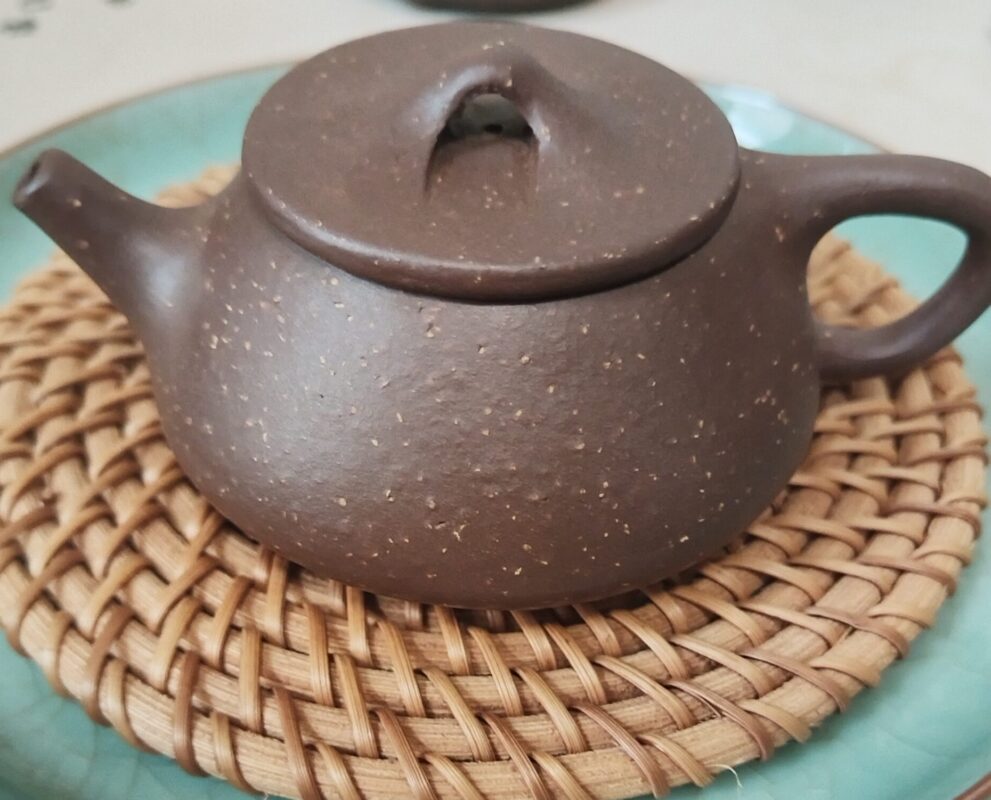
Oct
What is Tiao Sha? 调砂
Origin
Tiao sha is an old technique that can be traced back to the Ming Dynasty.
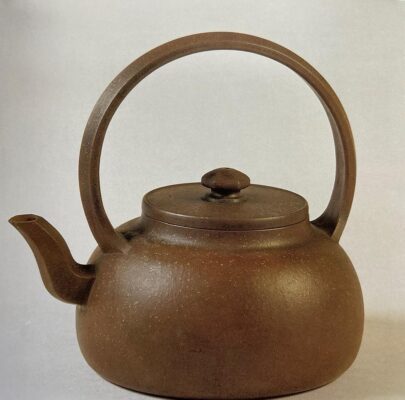
It is a decoration and craftsmanship technique for zisha teapots. While Shi Da Bin 时大彬 (1573-1648) was not the first person to use the method of tiao sha 调砂 (add sand content to the clay). His method of achieving this in the production of zisha teapots was groundbreaking. The technique of Tiao Sha was already used in ceramic production, but in the case of zisha teapots, Shi Dabin innovated and popularised it.
Here, there is a picture of one of his famous works, using tiao sha, in the Nanjing Museum:
How do potters use Tiao Sha 调砂?
It involves adding cooked or semi-cooked natural sand to the clay powder during clay refining, in a specific proportion and mesh size, ensuring a thorough and even combination of the two.
For example. In the case of tiao sha Zhuni, cooked sand 熟砂, they make it by grinding ore into a powder and then mixing it with water to make clay. Then they dry it in big bags, where it solidifies into bulky pieces. After that is placed into a kiln and fired at around 700-800°C. After firing, it’s ground and sieved to the desired grain size.
One example of Tiao Sha Zhuni mixture proportion is the Jing Dian Tao Fang Short pear-shaped pot, they mixed about 60目 Zhuni (mesh) with 20目 (mesh) coarse sand (cu sha). They use Benshan Lu ni 本山绿泥 as the coarse sand. The red and white complement each other, making the teapot more textured and appealing.
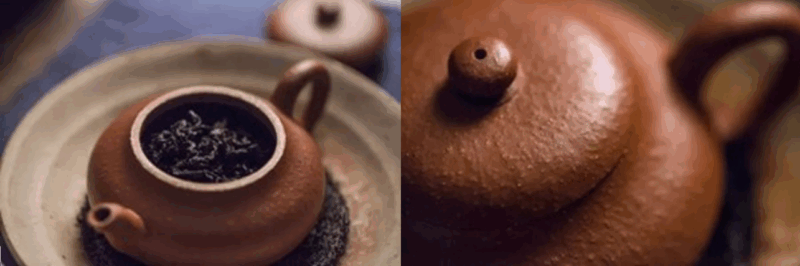
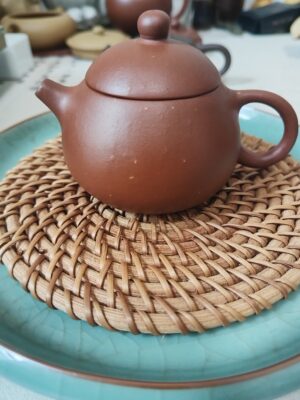
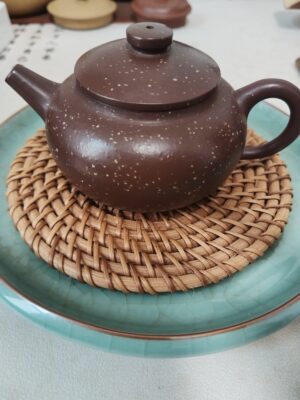
The following are examples from our collection of sheng sha (raw clay), meaning clay that has not been pre-cooked (fired) before firing the pot, mixed with cooked sand tiao sha:
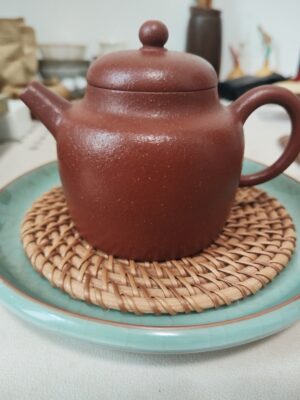
Tiao Sha Zhuni (with Ben Shan Lu ni cooked sand)
What are the advantages of adding cooked sand?
There are two main purposes: one is to make the finished product more layered and textured, to enrich the texture, and to increase the decorative effect. The second is to increase its air porosity, which is beneficial to the tea-appropriate function of Zisha.
Apart from the above-mentioned, adding sand also reduces the shrinking rate. This is especially beneficial when firing Zhuni teapots, which have the highest shrinking rate (above 20%). So, adding the sand to Zhuni clay can help to prevent these kinds of defects, as the one you can see in the picture below:
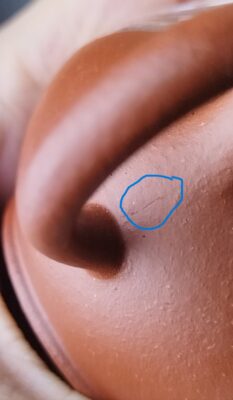
Sometimes, when the shrinkage is too high. The part where the handle is glued with the zhi ni clay to the body, will create a small gap or crack in the seam.